Rolling geometry · inverse problems · rotation groups
Trajectoids
A trajectoid is a body shaped to roll along a prescribed path.
Start with a periodic path in the plane. A trajectoid is a body shaped to roll along that path and its translated copies. Following the curve is a construction problem; repeating it requires the orientation to close.
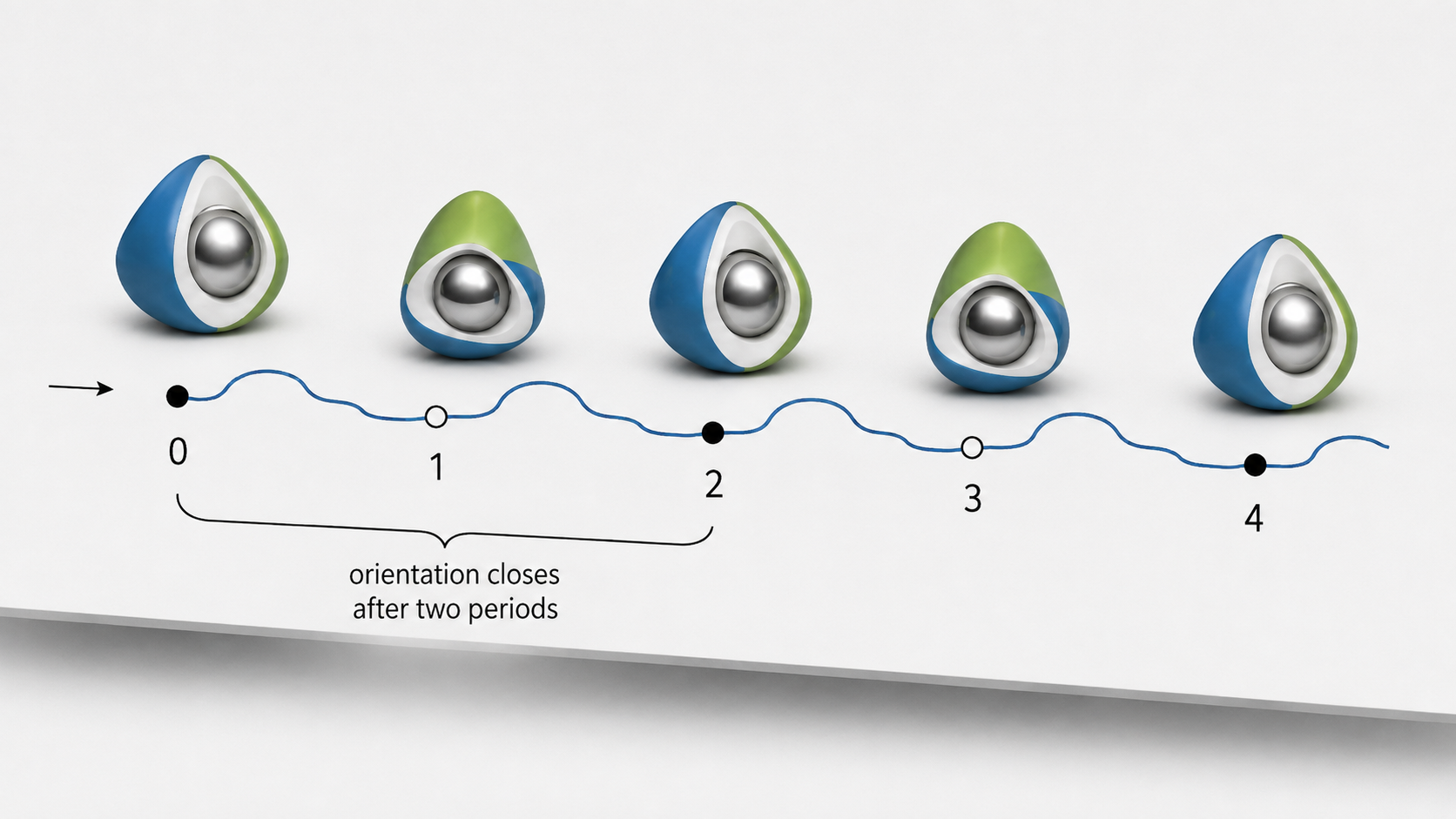
The decisive result is a theorem: for almost every path, one can choose the scale so that the body returns to its original orientation after exactly two periods. Return after one period is nongeneric.
From path to body
The construction algorithm was developed by Yaroslav Sobolev. A heavy inner ball is surrounded by a light shell. Rolling the prescribed curve on the ball traces the contact history; the shell is shaved so that leaving this history would raise the center of mass. Gravity then selects the prescribed motion.
Each path produces its own body. The shaving construction fixes the path-following geometry. Periodic rolling imposes the additional condition that the accumulated rotation close after an integer number of copies.
Rolling as a walk in SO(3)
One period of rolling gives a net rotation W(λ) in SO(3). The scale λ rescales all rotation angles together; geometrically, it is the relative scale of the path and the rolling body.
A one-period trajectoid requires W(λ) = I. A two-period trajectoid requires only [W(λ)]2 = I.
From finite return to two-period return
The earlier mathematical analysis showed that a prescribed path can be realized by a trajectoid that returns after some finite number of periods; the required number can, in exceptional cases, be large.
The later PRL result is sharper. For almost every associated rotation walk, two periods are enough once the common scale is chosen appropriately. Thus n = 2 is not merely frequent in examples; it is the generic theorem.
The two-period theorem
Eckmann and Tlusty proved that, apart from a nongeneric exceptional class, a rotation walk can always be uniformly scaled so that traversing it twice returns to the identity. In the language of the paper: almost every walk in SO(3) or SU(2) returns home when doubled and scaled.
At λ*, the single-period net rotation is a 180° rotation. The first traversal therefore changes the orientation; the second applies the same rotation again and restores the identity.
By contrast, a nontrivial solution of W(λ) = I after a single traversal almost never exists. This is why two-period trajectoids are generic while one-period trajectoids are exceptional.
See also Quantum structures in classical matter.
Related
- 2023 Sobolev YI, Dong R, Tlusty T, Eckmann J-P et al. — Solid-body trajectoids shaped to roll along desired pathways · Nature 620, 310–315
- 2024 Eckmann J-P, Sobolev YI & Tlusty T — Tumbling Downhill along a Given Curve · Notices of the AMS 71, 676–688
- 2025 Eckmann J-P & Tlusty T — Walks in Rotation Spaces Return Home when Doubled and Scaled · Phys. Rev. Lett. 135, 147201