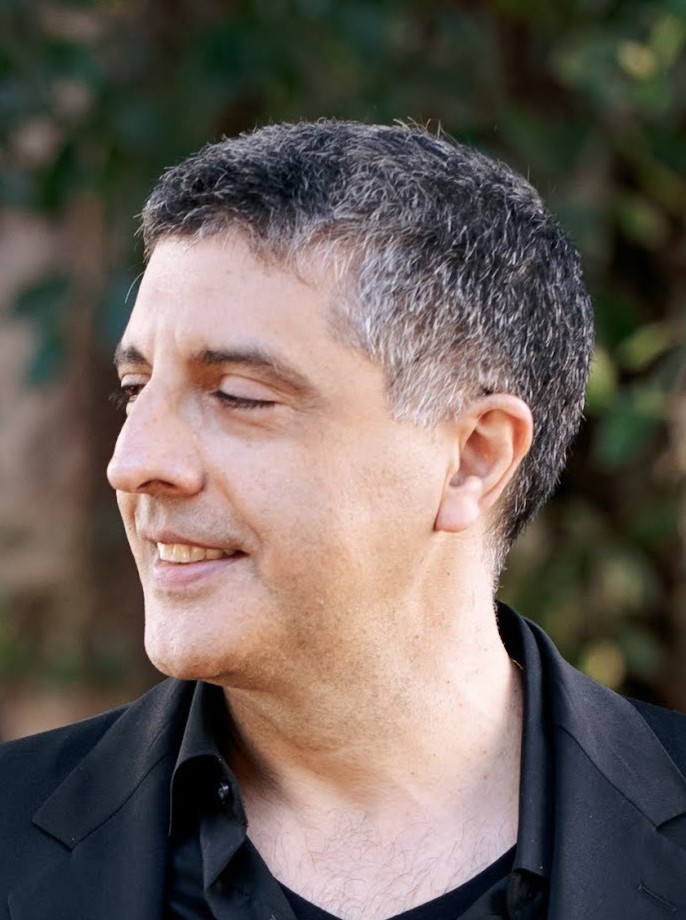
Tsvi Tlusty
I study how matter becomes machinery: how a slight asymmetry persists, propagates, and shapes what follows.
Distinguished Professor
Department of Physics
Ulsan National Institute of Science and Technology (UNIST)
Google Scholar · CV · UNIST · Email
The first problem is to decide what the physical object is. The genetic code is not just a table; error costs give it a geometry. A molecular recognizer is not a rigid lock; deformation can make a slight mismatch more specific than perfect fit. A protein is not a moving shape; function is carried by strain through an amorphous structure. And in water, the molecule may not be the whole object: its surface imposes boundary conditions on the surrounding liquid.
The cell makes the difficulty recursive. A DNA sequence becomes operative only through machinery that reads it; that machinery must itself be rebuilt. Reproduction is therefore reconstruction of the interpreter, boundary, and metabolism—not copying alone. This is the physical problem behind What Is Life?
Elsewhere I ask how much quantum structure requires quantum mechanics . Classical hydrodynamic matter can carry quasiparticles, flat bands, and exceptional topology; ordinary rotations lead directly to SO(3) and SU(2).
Appointments and education
- 2015– Distinguished Professor, Department of Physics, UNIST
- 2015–2025 Principal Investigator, Living Matter Theory Group, Center for Soft and Living Matter, Institute for Basic Science
- 2011–2015 Long-term Member, Simons Center for Systems Biology, Institute for Advanced Study, Princeton
- 2005–2013 Senior Researcher, Physics of Complex Systems, Weizmann Institute of Science
- 2000–2004 Fellow, Center for Physics and Biology, Rockefeller University
- 1995–2000 Ph.D. in Physics, Weizmann Institute of Science; supervisor: Samuel A. Safran
- 1991–1995 M.Sc. in Physics, Weizmann Institute of Science
- 1988–1990 B.Sc. in Physics and Mathematics, Hebrew University of Jerusalem